Why Can't I Stop Watching Porn? Am I a porn addict?
Updated: Jul 17
Why willpower isn't the problem—and why you keep returning to porn despite wanting to stop
Every week I speak to men who tell me the same story.
"I promised myself I'd never do it again."
For a few days—or sometimes a few weeks—they're motivated.
They install blockers.
Delete accounts.
Read books.
Pray.
Exercise.
Make promises to themselves.
Then life happens.
Stress builds.
Loneliness creeps in.
Arguments happen.
Sleep gets worse.
Work becomes overwhelming.
One evening they find themselves watching porn again.
Afterwards they feel ashamed.
They wonder:
"What's wrong with me?"
The answer is usually not a lack of willpower.
It's because they've misunderstood where relapse actually happens.
Imagine a steel beam
The Yield Point Framework comes from engineering.
When engineers test steel, they slowly increase the pressure.
At first, nothing changes.
The steel bends slightly but springs back into shape.
Then something important happens.
The pressure reaches what's called the yield point.
From that moment on, the metal permanently changes shape.
It hasn't broken.
But it no longer behaves the same way.
People have yield points too
Human beings aren't made of steel.
But psychologically, we work in surprisingly similar ways.
Every day we experience pressure.
Some pressure is healthy.
Deadlines.
Family responsibilities.
Exercise.
Challenges.
But pressure also comes from:
stress
anxiety
loneliness
shame
boredom
exhaustion
conflict
rejection
uncertainty
Most of the time we cope.
But pressure keeps building.
Eventually we reach our own psychological yield point.
That is the moment our thinking changes.
The mistake most people make
Most men believe relapse starts when they open a browser.
It doesn't.
Porn is usually the final behaviour.
The relapse began much earlier.
It started when stress exceeded your ability to regulate it.
By the time you're searching for porn, your brain has already shifted into survival mode.
This is why saying:
"I just need more willpower."
rarely works.
Your brain isn't making calm, rational decisions anymore.
It's trying to reduce emotional pressure as quickly as possible.
Porn happens to be one of the fastest ways your brain has learned to do that.
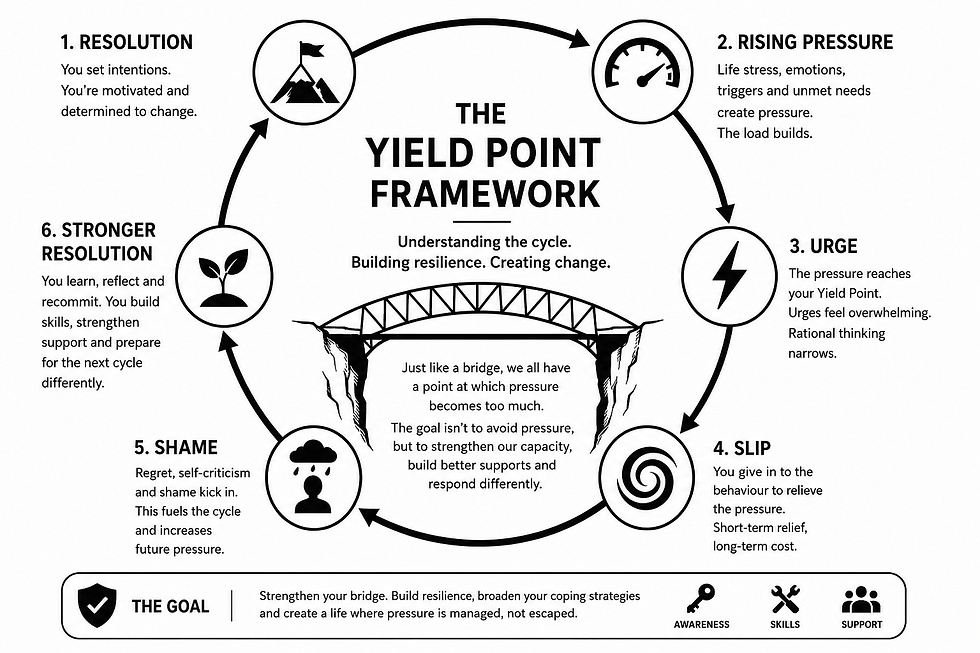
The Yield Point Cycle
The Yield Point Framework describes relapse as a cycle.
1. Resolution
After a relapse you're determined.
You make rules.
You promise yourself things will be different.
Motivation is high.
Pressure is low.
2. Rising Pressure
Life continues.
Work becomes stressful.
Relationships become difficult.
Sleep suffers.
You stop exercising.
Maybe you become isolated.
Pressure gradually builds.
Often you don't even notice.
3. The Yield Point
Eventually the pressure exceeds your current ability to cope.
This is the critical moment.
Your thoughts begin to change.
You may notice yourself thinking:
"Maybe just once."
"I've had a hard day."
"I'll start again tomorrow."
"No one will know."
These thoughts don't cause the relapse.
They're signs you've already crossed your yield point.
4. Acting Out
Porn temporarily reduces the pressure.
Your brain gets relief.
Unfortunately it also strengthens the pathway that says:
Pressure → Porn → Relief
The cycle becomes easier to repeat.
5. Shame
Immediately afterwards comes guilt.
Disappointment.
Self-criticism.
Many men tell themselves they're weak.
Broken.
Hopeless.
Ironically, shame increases emotional pressure.
Which means the cycle starts again.
Why blocking porn isn't enough
Many recovery plans focus entirely on removing access.
Blockers can help.
Accountability can help.
Environmental changes matter.
But they don't change your yield point.
If pressure keeps exceeding your coping capacity, your brain will simply search for another escape.
Real recovery involves increasing your capacity to stay below your yield point—or recognising when you're approaching it.
Recovery is about moving your yield point
This changes everything.
Instead of asking:
"How do I stop watching porn?"
we ask:
"What pressure am I carrying?"
and
"What skills help me regulate it?"
Recovery becomes less about resisting urges and more about building resilience.
That might include:
learning emotional regulation
improving sleep
reducing chronic stress
strengthening relationships
challenging shame
recognising early warning signs
creating healthier ways to meet emotional needs
Over time your psychological yield point moves.
The same stressful day that once triggered porn no longer overwhelms you.
The goal isn't perfection
Everyone reaches their yield point occasionally.
The aim isn't to become someone who never struggles.
It's to notice pressure earlier.
Recover more quickly.
Respond differently.
Every time you interrupt the cycle, you teach your brain a new way of coping.
That's how lasting change happens.
Not through fear.
Not through shame.
But through understanding.
How therapy can help
One of the biggest advantages of therapy is that you don't have to figure this out alone.
Together we identify:
what creates pressure in your life
where your yield point currently sits
the situations that consistently move you towards it
practical strategies to increase your resilience
Recovery isn't simply about stopping a behaviour.
It's about becoming the kind of person who no longer needs that behaviour to cope.
The Yield Point
The question isn't:
"Am I porn addict? Why can't I stop?"
The better question is:
"What pressure had I been carrying before I reached my yield point?"
Once you understand that, recovery starts to make sense.